 By
In his studio in Plancher-Bas, at the foot of the Vosges mountains, Romain Wetzel turns tar and steel into a language. With The Fall of Modulor, he confronts Le Corbusier’s utopia as much as his own certainties. Against the theory of proportions, he sets the density of matter. By toppling the colossus, the artist restores its humanity: that of a man who falls because he is alive.
Shards od Matter
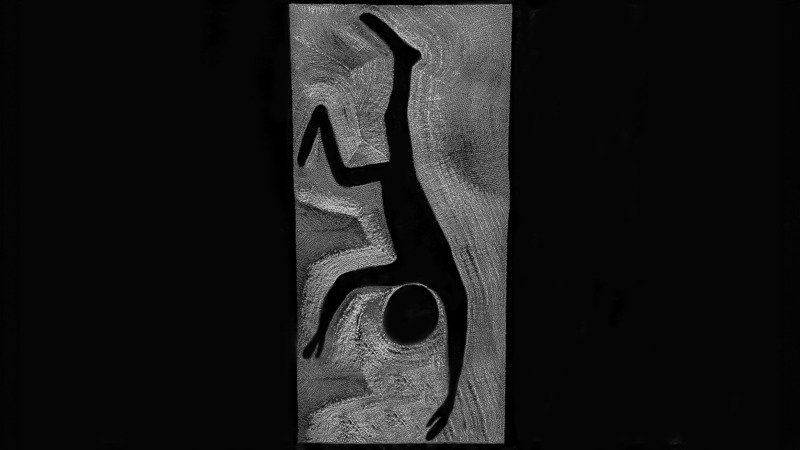
At first glance, the mass is dark, almost unsettling. The Modulor, a man of metal, is hurled headfirst. As the eye adjusts, the material begins to speak. A hundred thousand steel spikes, packed tightly together like so many soldiers on a battlefield, form his silhouette and make it radiate. Each one absorbs the light and scatters it into shards. In this close struggle between shadow and light, the mass trembles, the iron blazes.
Metal can shine, blacken or lose its lustre; even stainless steel bears the marks of time. Wetzel accepts this and lets his works age, like ancient statues whose colours fade without their strength ever dimming. Nothing here reveals itself at once. Black and reflections coexist. Light does not erase shadow; it shelters it.
 © Romain Wetzel · Metal · All Rights Reserved
In a Land Without Paths
In the north of Franche-Comté, an inland sea sleeps in the heart of the land. The Champagney reservoir is the work of human hands, a body of water designed to feed a canal that was never completed. Not far from there, on a small farm a stone’s throw from the family home, Romain Wetzel has put down roots. All around, the countryside is poor and sombre. Wheat fields sit alongside former mining sites, and in the valleys the remains of factories recall a time when metal was shaped here. People were both farmers and miners, like his grandparents, their hands put to the soil and to the coal alike.
Wetzel carries a deep imprint of this mineral landscape. The black of tar answers the gleam of metal. On one side, the earth holds the light; on the other, steel throws it back. The artist’s whole imagination springs from this contrast, two expressions of a single universe that he makes his alphabet. From childhood, he has felt drawn to abstraction and the invisible, to inner landscapes that elude the contours of the sensory world. Out of love for life, he turns this harsh land into fertile ground. The dialogue between black and brilliance runs through all his work. For him, light is the tomb of shadow.
As a child, he grew up among ruins, between tumbling stones and black beams.
Humanity Regained
The white chapel at Ronchamp, Le Corbusier’s iconic building, has left a deep mark on Romain Wetzel’s imagination. His confrontation with the architect, whose view of the world he questions, blends fascination with resistance. Drawn to this conception of man at the centre of architecture and knowledge, he nonetheless contests the human model it establishes as a universal reference, its proportions rigorously codified.
For him, matter is a way of thinking about the world, and the work a means of transforming oneself rather than others.
By making the Modulor fall, he wants to give this abstract figure back a human history and fragility. He does not seek to impose another truth, but to let us glimpse a world of extraordinary possibilities, far vaster than reality. This freedom, won from himself, is perhaps what he hopes to share.
In the dark tones of this work, as in its glints, the quest takes the form of a struggle. It promises no happy ending, but expresses the will to make light prevail without ever denying the darkness.
© Lead photograph · Romain Wetzel · The Fall of Modulor · 244 × 122 cm · All Rights Reserved