
 By
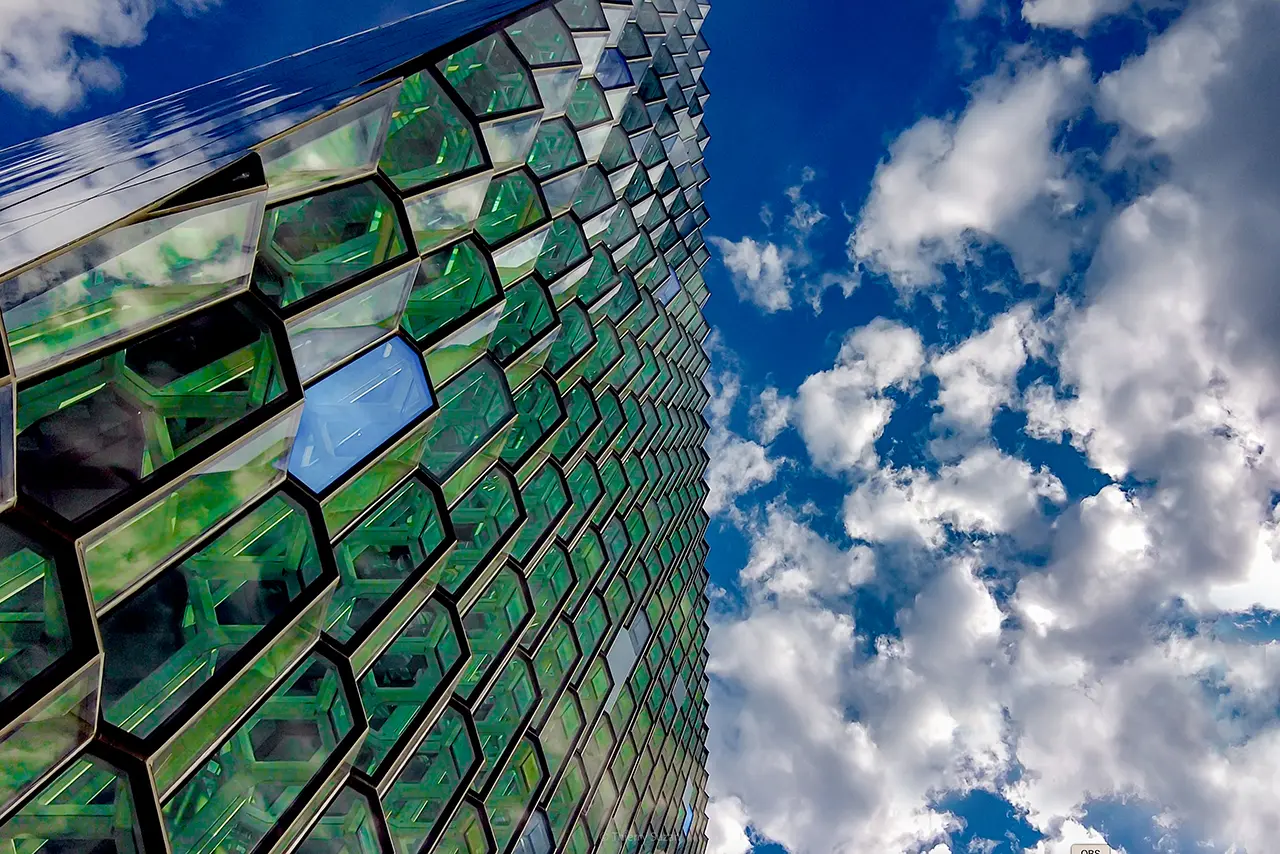
By Designed by artist Olafur Eliasson in collaboration with Henning Larsen, this cultural landmark rises from Reykjavik’s docks like an unstable, shifting, almost liquid structure. Its honeycomb glass façade captures the boreal light—diffusing, fracturing, and reinventing it. Nothing is fixed. Everything is vibration. More than a concert hall, Harpa has become the emblem of a nation that draws its strength from the dialogue between the elements and creation.
The Vibration of Crystal
The sea is close by, breathing through the harbour’s edge. Inaugurated in 2011, Harpa seems to rise from that very breath. Modules of glass and steel wrap the building like the skin of an artificial organism. From a distance, the façade resembles a crystalline lattice—a geological formation that has learned to reflect the sky. Up close, it becomes motion. Each panel catches a fragment of reality and returns it transformed.
Icelandic light, low‑lying and restless, never illuminates the building in quite the same way. It pierces through and recomposes it. The edifice changes face with the hours, the seasons, and the storms rolling in from the open sea, until any sense of a fixed backdrop vanishes. Inside, it is at once concert hall and instrument. Silence here has a particular density, and the volumes are shaped for resonance, for amplifying what does not yet exist. In the main hall, music is not projected toward the audience but travels through them, carried by an invisible architecture.
 © Thierry Suzan · Harpa · All Rights Reserved
A Prism of Sound and Light
Then comes another Harpa—more secretive, silent in its own shimmer. Here, the building ceases to be a mere feat of architecture and becomes a hive of light, a swarm of glass suspended between the waters and the void. Each cell seems to trap a fragment of blue, each edge a sliver of wind, as if the architecture had stolen from the bees the secret of building air without ever enclosing it. Nothing here is massive; everything is held together by a network of fragile relations, a permanent dialogue of clarity between the crystalline bodies.
Its honeycomb glass façade captures the boreal light—diffusing, fracturing, and reinventing it.
Within this labyrinth of transparency, the visitor does not so much get lost as let themself be infiltrated by the world’s radiance. One no longer walks through a building, but drifts through the heart of a living geometry where the gaze grazes on reflections from the open sea. It is here that the work of Olafur Eliasson and Henning Larsen reaches its climax, transforming concrete into a diaphanous substance.
Harpa is no longer a border between land and foam, but a filter where light comes to rest. At twilight, when the steel fades and all that remains is the glow of thousands of facets, the building becomes an immobile beacon, a radiant offering laid down at Iceland’s threshold.
© Lead photograph · Thierry Suzan · Reflection · All Rights Reserved