
 By
By Every morning, before the heat settles over Amarapura, thousands of silhouettes make their way across the long wooden bridge stretching above the water. Monsoon after monsoon, pillar after pillar, U Bein carries within its grain the hush of memory. The bridge is more than a relic. It remains a place where the country continues to connect with itself, despite the fractures of its history. At dawn and at dusk, this unchanging ribbon becomes more than a passage between two shores: it is a crossing into Burmese time.
The Suspended Moment
At first glance, the bridge seems motionless — a line drawn across the water, so steady it feels as though it has always belonged to the landscape. In the still-uncertain light, the teak absorbs the reflections of day without ever quite holding onto them. Then the wood turns to amber and copper. Countless pillars stretch across the water like shadows. Already, the horizon begins to slip away.
Suddenly, bursts of color pierce the mist. Monks step forward; as the gold of dawn filters through the folds of their garnet robes, the fabric unfurls like wings of fire. Beneath their bare feet, the wood emits a low, hollow creak, answering the soft, persistent lapping of the lake. No sooner formed than they fade — these fleeting impressions dissolve almost at once.
For U Bein resists capture. Its enigmatic structure sharpens intuition more than understanding. One no longer quite knows whether one is looking at a bridge or at the lingering trace of a dream. Wood, water, and air merge into an illusion of depth. Contemplation slips, almost imperceptibly, toward the invisible.
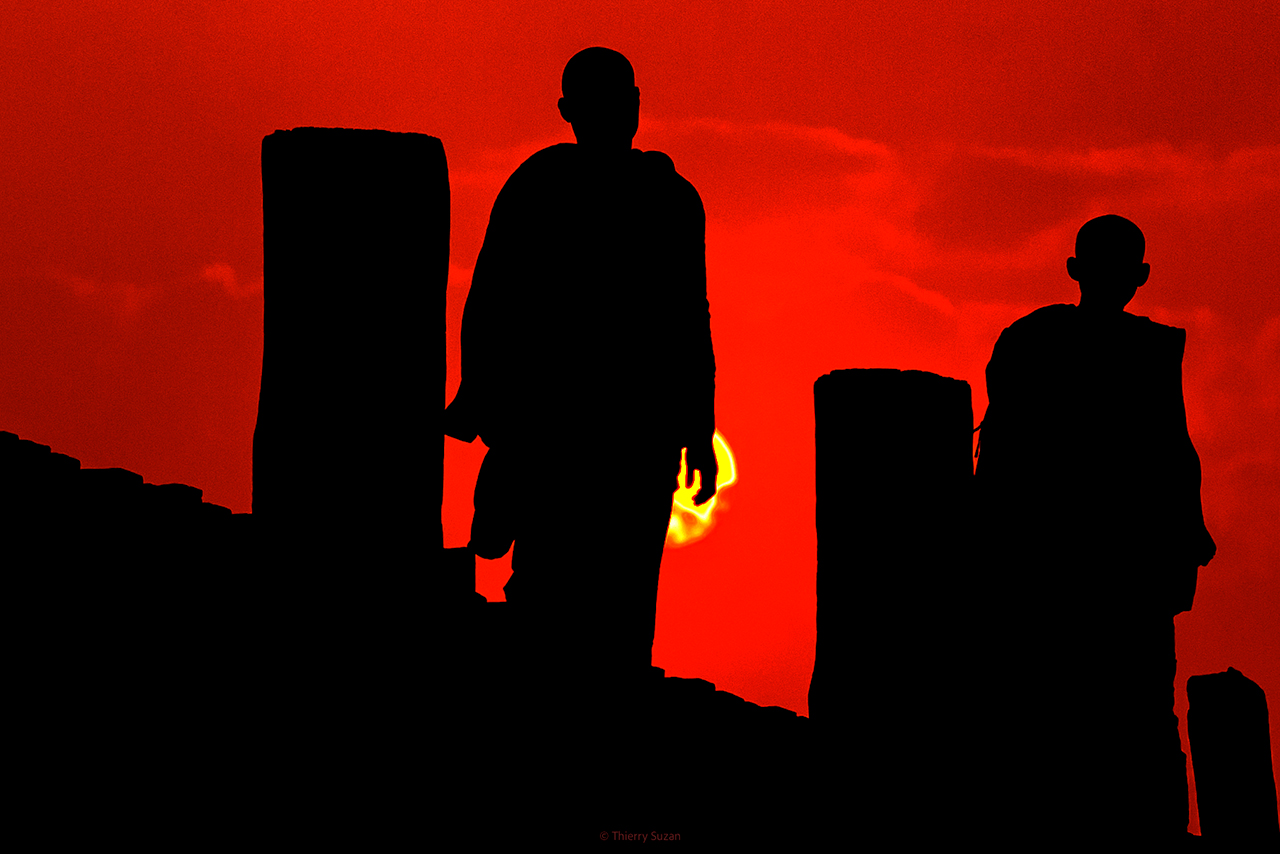 © Thierry Suzan · Monks · Amarapura · All Rights Reserved
The Memory of Wood
Before spanning the waters of Taungthaman Lake, the teak of U Bein belonged to other structures, displaced across centuries. The bridge was not built from nothing, but assembled from successive worlds. Burmese palaces are not immutable monuments; they are living structures, dismantled and rebuilt in response to exile, earthquakes, and fires that punctuate the fate of royal cities. In Myanmar, wood does not vanish with dynasties: it circulates, carrying with it the very continuity of power.
When King Mindon moved his capital to Mandalay in the mid-nineteenth century, the teak elements of the palace at Inwa — a former royal capital — were left behind. U Bein, then mayor of Amarapura, reclaimed them and had them transported to the lake’s edge. The bridge emerged less as a construction than as an assemblage of former lives. Each beam, each pillar, each plank has passed through multiple imperial existences before finding its final anchorage above the water.
At dawn and at dusk, this unchanging ribbon is no longer just a passage between two banks, but a journey through Burmese time.
The teak makes this unmistakably clear. Some beams have darkened; others have cracked or bowed under the monsoons and the wear of daily use. Nothing here suggests the sterile perfection of a monument restored to the point of erasure. U Bein retains the appearance of a material shaped — and reshaped — by time. Each element seems to belong to a different layer of royal Myanmar, as if the bridge, in its very substance, resists oblivion.
What Time Does Not Erase
The teak of U Bein was once a tree, and that origin is never forgotten. Its durability reveals something essential about the Burmese understanding of time: a force that does not oppose change, but is nourished by it. The bridge does not withstand the centuries; it evolves with them.
The water rises, recedes, and returns in an inexorable cycle. The wood wears away, eroded by humidity and the passage of footsteps, yet each repair avoids fixing the past in place. Instead, it extends what accepts never being complete — a work in perpetual motion. Nothing is final. The bridge endures precisely because it consents to change.
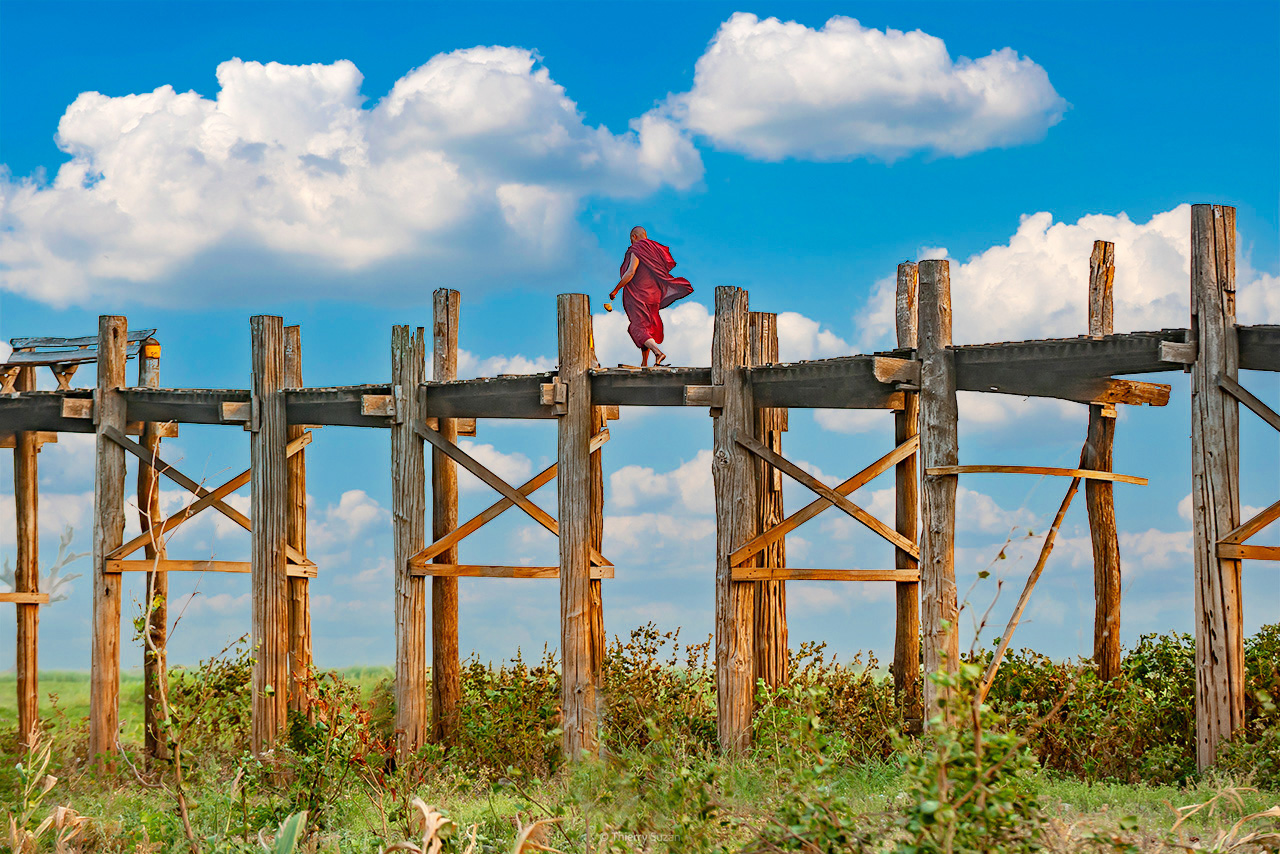 © Thierry Suzan · Bridge · Amarapura · All Rights Reserved
This material resilience echoes Myanmar today. As the country passes through darker times, the bridge remains a silent witness to its endurance. Regimes shift, eras collide, yet the crossing remains. The world may move — or fracture — around it, but the structure holds its course. It weathers the upheavals of history, countering the violence of the age with the quiet obstinacy of its presence.
There is no visible permanence here, only a trace of existence. The bridge signifies nothing beyond its own reality. It continues
© Lead photograph · Thierry Suzan · U Bein · All Rights Reserved