 By
By In Luca Barberini’s studio in Ravenna, thousands of fragments lie waiting. Not ideas — materials. Glass, enamel, stone, colored mortar. Shards that have already lived one life before beginning another. This is where everything starts: not from a vision of the world, but from matter the hands know before the mind decides. Here, in a city that has been thinking in tesserae for fifteen centuries, an artist transforms an ancient gesture into a way of holding the world together.
The First Gesture
It all begins with a gesture: breaking. Before the image, before composition, before meaning — there is rupture. The tessera exists only because something has been shattered. It is the result of a gentle violence, a controlled fracture. And it is from this fracture that Barberini builds.
This gesture is not neutral. To make the fragment the basic unit is an originary choice. It asserts that reality can only be grasped in pieces. That every image is provisional. That meaning is never given — it is negotiated, tessera by tessera, in the unstable space between fragments.
What we see in his work, then, is not a result. It is a process suspended at the moment it becomes visible. The mosaic does not represent the world — it shows how we try, patiently, to reassemble it.
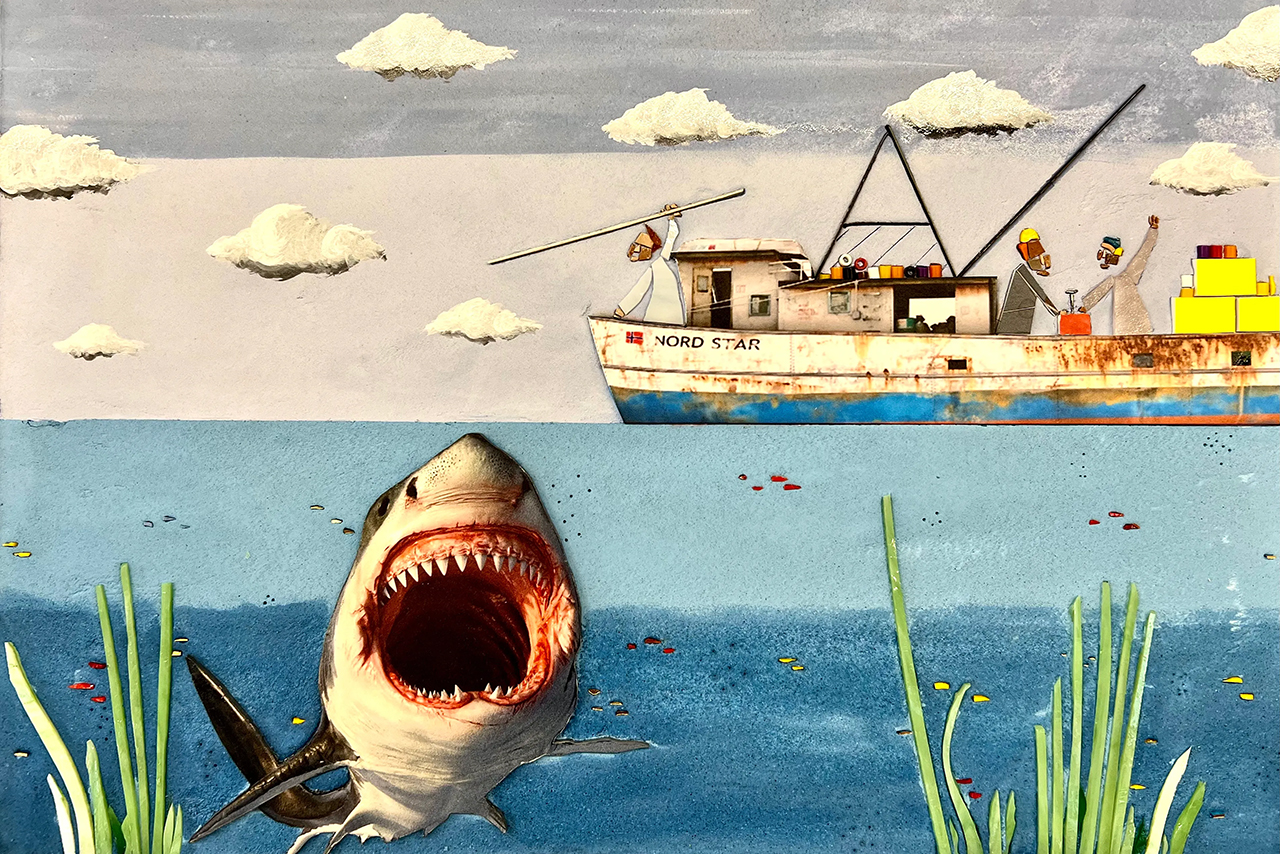 © Luca Barberini · Lo Squalo · 39.4 × 52 cm · All Rights Reserved
Ravenna, Grammar of Light
Mosaic carries an inherent ambivalence: it is both fragmentation and continuity. Each tessera is an autonomous unit — yet their assembly produces a form of duration.
In Ravenna, mosaic is not merely an art form — it is a way of thinking. Byzantine surfaces are not images: they organize light the way other civilizations organize language. The sacred and the political are read in the same grammar — that of tesserae, fragmented light, meaning revealed only in pieces. A logic Ravenna has never abandoned.
Barberini works within this continuity, but shifts its register. Material is never neutral. It carries a living, nonlinear memory, made of layers and adjustments. Each tessera becomes a unit of time: that of a gaze assembling what never stops dispersing.
In Ravenna, a city that has been thinking in tesserae for fifteen centuries, an artist transforms this ancient gesture into a way of holding the world together.
The World Seen from Screens
As a child, Barberini would watch twenty television screens simultaneously from the street. This formative image says everything: the world is not only experienced — it is seen, multiplied, simultaneous, distorted.
This is the condition he translates into mosaic. His works do not represent the contemporary world: they mirror its mental structure. Yesterday’s and today’s information intermingle, reshape one another, take on grotesque forms, until what was real becomes surreal — and what belonged to dreams becomes real.
Faced with the saturation of images and the ordinary violence of daily life, Barberini responds through metaphor and commitment. Each tessera, hand-cut, is both an autonomous fragment and part of a whole that exists only through assembly. It is precisely this logic — the recomposition of meaning from heterogeneous fragments — that makes mosaic his natural medium. Surreality is not an aesthetic stance, but the form reality takes when looked at head-on: fragmented, then reassembled.
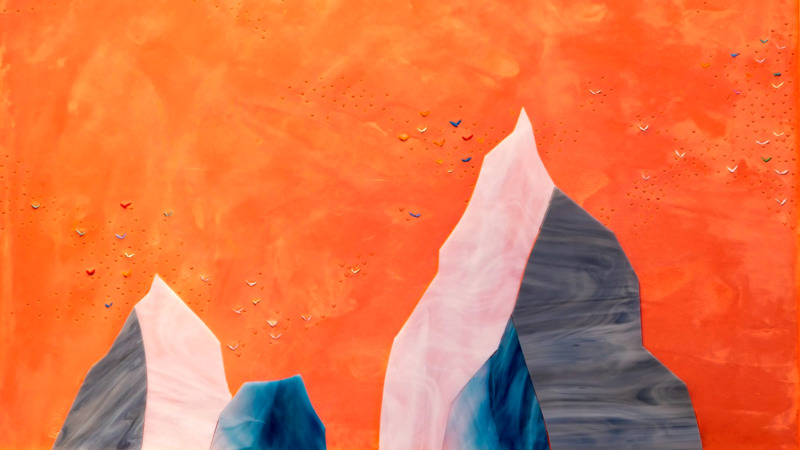
© Lead photograph · Luca Barberini · Tessere Sogni · 100 × 100 cm · All Rights Reserved